IT Governance & Audit
Trail Compliance: The Constitution and the Evidence
In the era of the DPDP Act, digital compliance requires a
dual approach: robust IT Governance to set the rules and rigorous Audit Trails to prove they are followed
CS Raju S Surapuraju assists in drafting your digital
"constitution"—from policies to risk frameworks—while advising on the technical architecture needed to capture admissible evidence
By integrating strategic oversight with tamper-proof
logging, we ensure your organization can demonstrate accountability from the server room to the boardroom
Beyond Logging: Establishing Proof of Compliance
Under the DPDP Act, 2023, a Data Fiduciary’s primary obligation is not just to protect data, but to demonstrate accountability. In the event of a regulatory inquiry or a grievance by a Data Principal, your
system must provide irrefutable evidence.
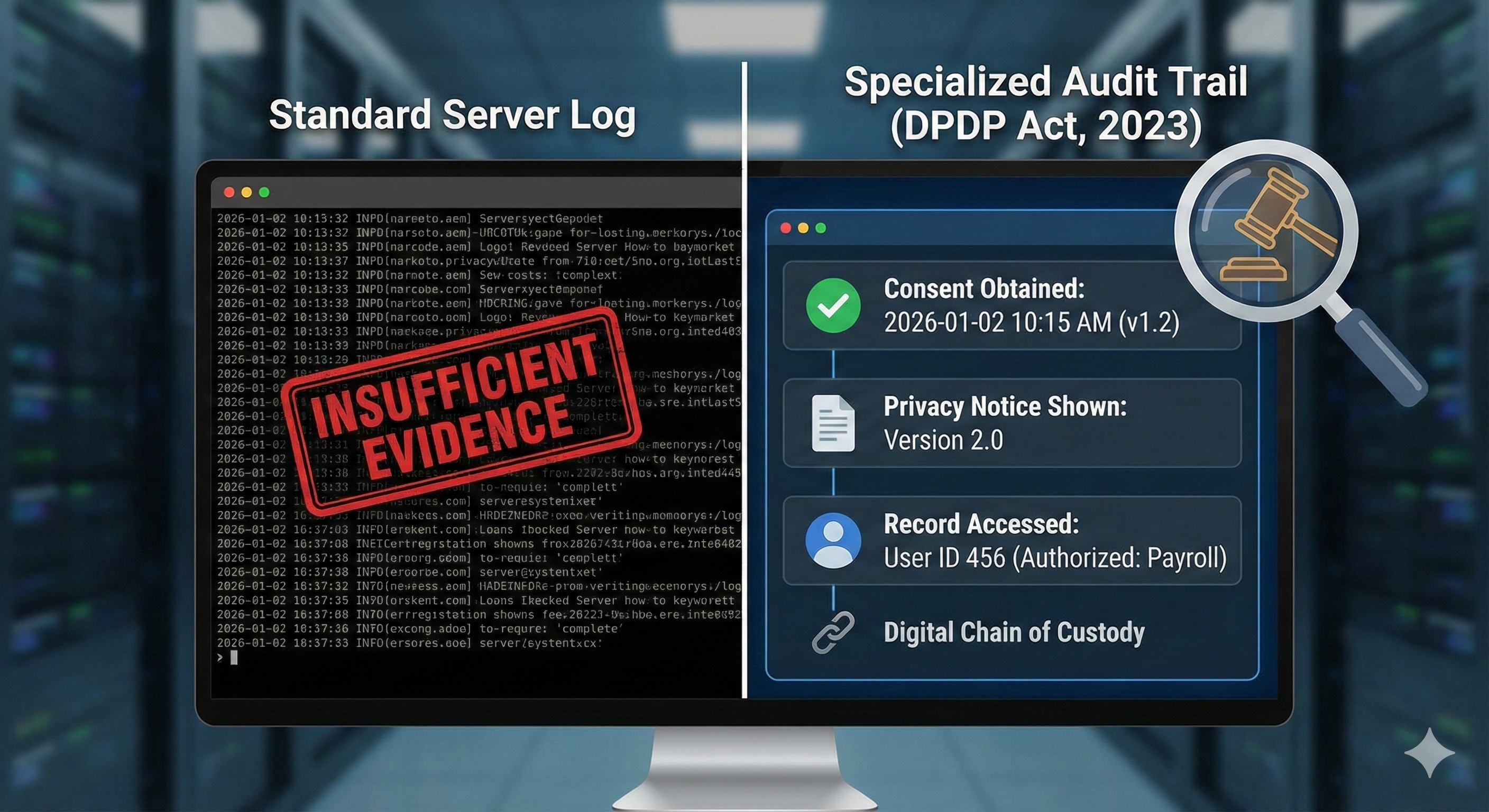
A standard server log is often insufficient. Compliance requires a specialized Audit Trail that legally validates specific
actions: When was consent obtained? Which version of the Privacy Notice was
shown? Who accessed this specific record and why? Without this granular
"Digital Chain of Custody," an organization remains vulnerable to penalties despite best intentions.

Designing Legally Admissible Audit Architectures
CS Raju S Surapuraju advises organizations on structuring audit mechanisms that stand up to scrutiny. The goal is to transform raw system data into a coherent compliance narrative. Consent Ledgering: Advising on database structures that permanently link a user’s identity to the specific consent artifact they agreed to (timestamp, IP, and form version).
Immutable Logging: Guiding the implementation of "Write-Once-Read-Many" (WORM) principles to ensure that critical compliance logs cannot be tampered with by internal staff. Attribution & Granularity: Defining protocols to ensure every data interaction—view, edit, or delete—is strictly attributed to a verified user identity.

Bringing the Server Room into the Boardroom:
In the modern digital economy, Information Technology is no longer a support function—it is a governance issue. Boards are increasingly held liable for cybersecurity failures and data breaches.
CS Raju S Surapuraju bridges the critical gap between Executive Management and IT Operations. The practice focuses on aligning IT strategy with corporate business goals, ensuring that technology investments deliver value while strictly adhering to regulatory risk frameworks. We move IT discussions from "uptime" to "governance," ensuring Directors can exercise proper oversight.

Structuring the Digital Organization
Robust IT Governance requires more than software; it requires a constitution. We assist organizations in drafting and implementing the policies that govern their digital life.
Access Control Policies: Defining "Who accesses What" based on the
Principle of Least Privilege.
Incident Response Protocols: Structuring the legal and technical workflow for
breach reporting (required within specific timelines under various laws).
Vendor Risk Management: Establishing criteria to evaluate and monitor
third-party software vendors, ensuring your supply chain does not become
your compliance weakness.